
You Asked, I'm Answering: The top 10 Questions I Get Asked Most
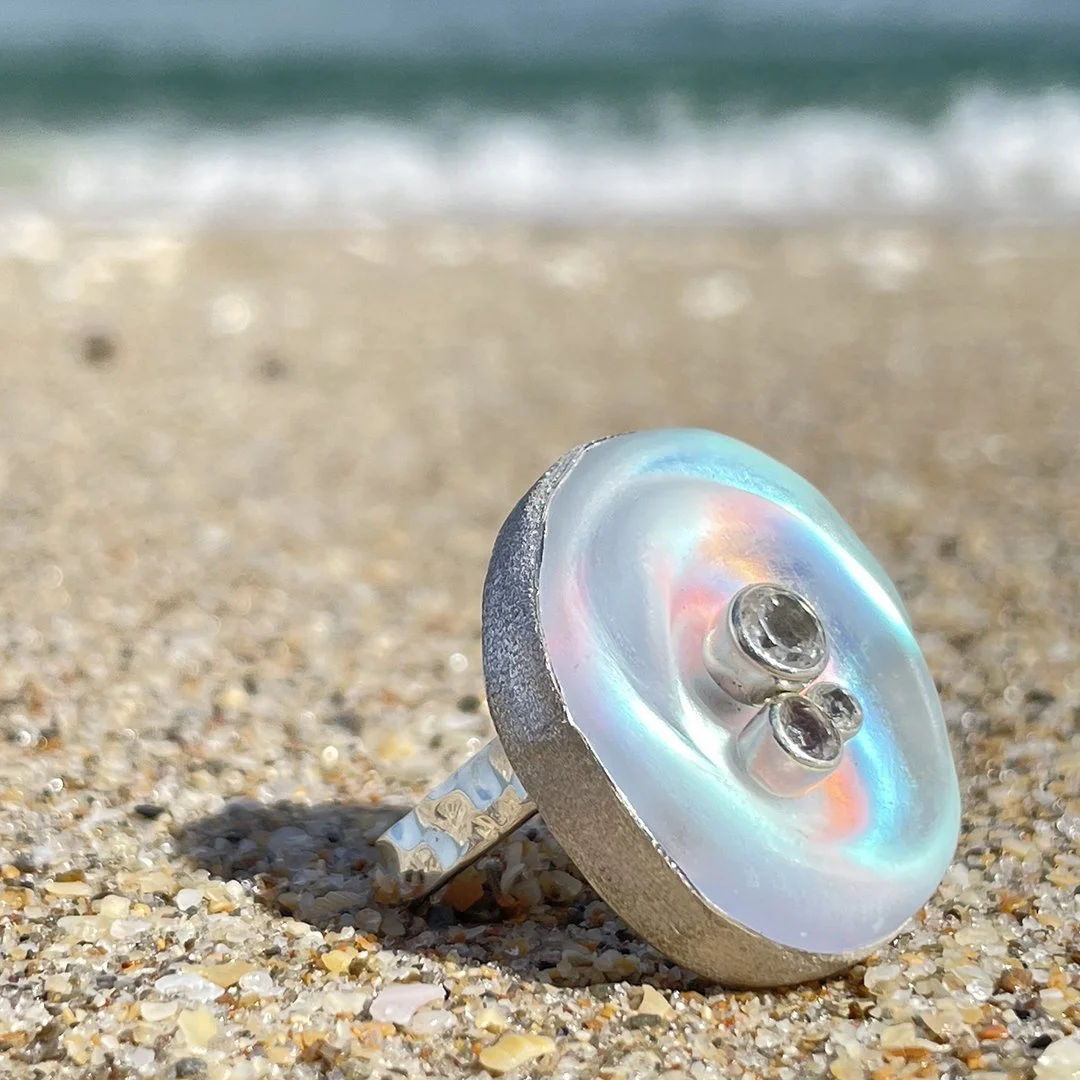
Ocean inspired, not ocean made.
1. The most obvious question…Is it sea glass?
Do you find it on the beach?
Ugh.
This my absolute top, most asked question, and it comes in many forms. In all honesty, it kind of annoys me that someone would think that I find all my intricately carved and distinctively opalescent glass on the beach, but yeah, I get asked this a million times a day at shows. More variations and perhaps less annoying: do you press it into a mold? Where do you buy it? And my personal favorite, asked by several children over the years, especially back when my hair was pink: are you a mermaid?
Yes, I am. But shhhh, don't tell anyone. It's a secret.
The real answer: I make the glass myself through a series of laminations, then shape it using a technique called cold working. The short answer is that it starts as raw materials and becomes something entirely my own. For the longer answer, my last blog post covers the whole process. [Read it here.]
2. How long does it take me to make a piece?
The short answer: a very long time.
The longer answer: I never make a piece from start to finish in a single day. My work happens in stages, and different days are for different things. Some days I laminate glass. Some days I carve. Some days I do silversmithing, some days polishing. And then there are those very special days, when my mood is just right and the moon is in alignment with Jupiter, when I actually finish pieces and set stones.
Those days require a very particular state of mind. Setting stones is the final step, the point of no return. One wrong move and I've just destroyed everything I've spent hours, sometimes days, creating. So, I wait until I'm really, truly ready. And then I go for it.
Honestly, it's hard to calculate the total hours in any meaningful way, because almost nothing gets made in a single workday.
Here's a glimpse at how it actually works: I typically laminate about eight pieces at a time, which takes roughly a full day just to prepare. The optical glass has to be cut from a larger block and brought up through progressively finer grits before it's even ready to laminate. Each piece then gets anywhere from one to four laminations. That's just to create the raw glass block, before a single carving mark has been made.
Once the glass is cured, I move into carving, usually six pieces at a time. Not all of them survive the grinding process, and honestly, not every piece I make is something I love enough to use. Those go onto trays to potentially become jewelry later.
Metalwork runs on its own rhythm too. I work on three pieces at a time, rotating between them while each one pickles after soldering. Once the metal reaches a certain point, I get anxious to see how everything turns out, so finishing and polishing tend to happen in a concentrated push. Stone setting requires its own very specific mood.
And then there are the unglamorous days. Netflix on in the background, assembling chains, making components for future pieces. Grunt work, but necessary.
My workday runs roughly 8:30 to 6 with a half hour for lunch, almost every day I'm not at a show. And still, almost nothing ever gets made start to finish in one sitting.
So how long does a piece take? A long time. That's really the only honest answer.
3. Will the silver tarnish?
Yes, it will. Sterling silver tarnishes, full stop. That's not a flaw, it's just the nature of the material. The good news is it's easy to manage.
I say this all the time at shows, so if you've already heard it, just skip ahead, but I hoard those little desiccant packets that come free in every purse, new pair of shoes, pretty much everything you buy. I keep them in with my jewelry because they absorb moisture, which is essentially what prevents the silver from tarnishing in the first place. Storing your piece in a small airtight plastic bag when you're not wearing it helps too. Between the two, you can go a long time without ever having to clean it.
But in the event that you do need to clean it, use a rouge cloth on polished areas and a 3M Scotch-Brite pad on anything matte or textured. Different surfaces, different tools.
For the glass, I use glass cleaner on a soft paper towel, or plain dish soap. Either works beautifully. Another pro tip: I often use my blow dryer to make sure there's no moisture left before I put things away. Just go easy on the heat setting. You want to blow out the moisture, not cook the jewelry.
If your piece has gemstones, pay attention to what they are. Tarnish removers like Tarnex can be used carefully with a Q-tip on the silver but keep them away from the stones entirely. Opals and pearls are porous and can absorb chemicals that will affect their luster. Also, be sure to thoroughly flush the piece with water after using any chemicals, and again, make sure it's completely dry before storing.
A few things to avoid across the board: swimming, showering, chlorine, saltwater. Anything high impact. Perfume, lotion, and cleaning products. And sudden temperature swings aren't great for the glass or the stones, so don't leave your piece somewhere it'll go from one extreme to another.
These pieces are built to last. With a little basic care, they'll stay beautiful for years, and honestly, for generations. I love the idea that something I made by hand could become a family heirloom someday.
4.Will the glass break?
This one I totally understand. When you think of glass, you think of fragility. But glass is also everywhere around us, protecting us. Your car windshield. The screen on your phone. The windows in your home. Glass is actually remarkably strong when it's engineered to be.
Here's something most people don't know: all glass contains metal. Typical window glass has copper in it, which is why the edge looks green. Most people are familiar with lead crystal, which is optically pure and beautiful, but the lead content makes it soft and very heavy. Not suitable for jewelry.
The glass I use is made with platinum instead, which makes it optically pure and exceptionally hard. Then it's laminated, bonding multiple layers together, which makes it even more durable. If it takes a hit, the interlayers hold everything together rather than shattering, more like safety glass than a drinking glass.
That said, I'm not going to tell you it's indestructible, because it isn't. Even a diamond can be broken. It's still glass, and it should be treated with some basic care. But for everyday wear? It's remarkably resilient. I've been making jewelry for almost 30 years, and these pieces are built to last.
5.Wait, is that ring square?
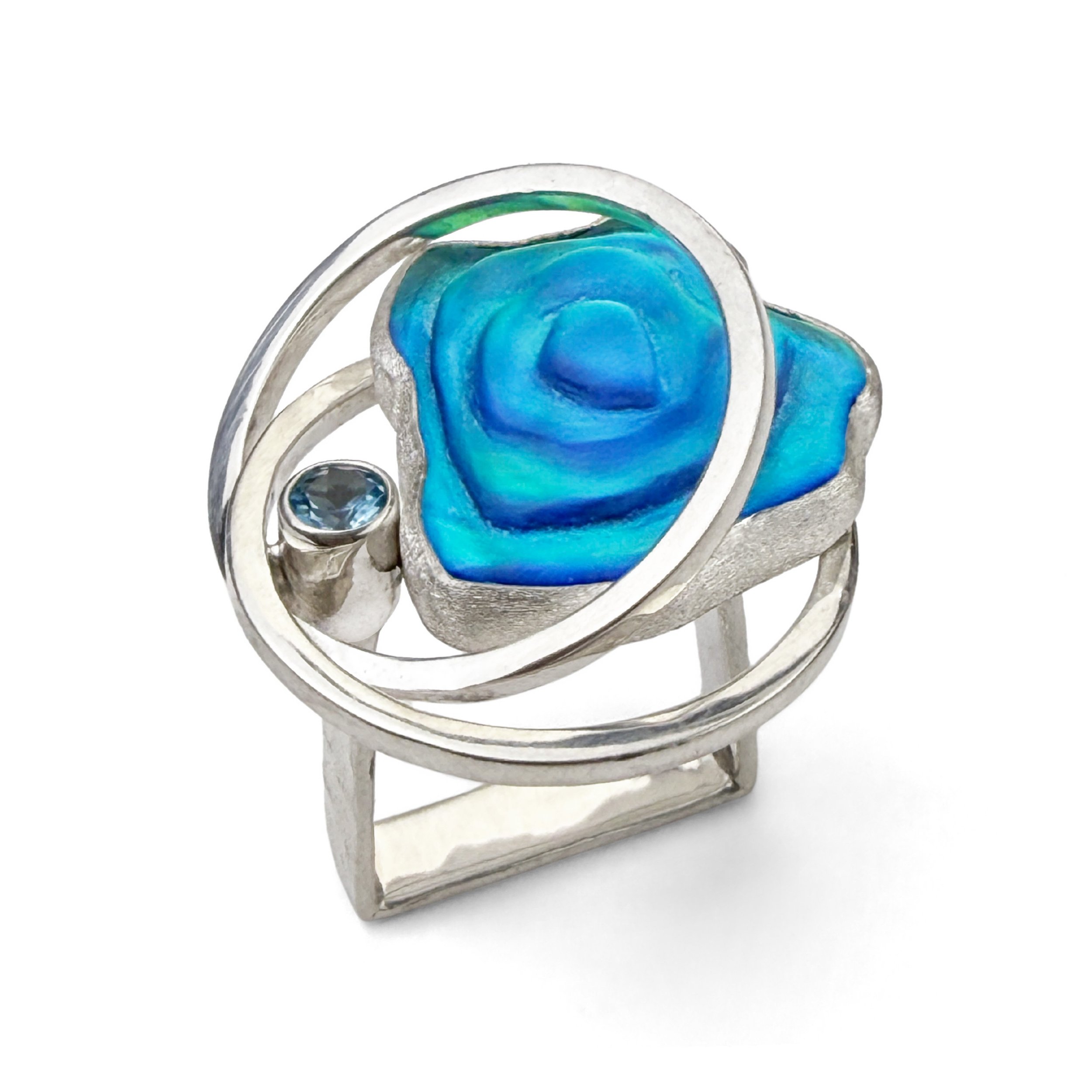
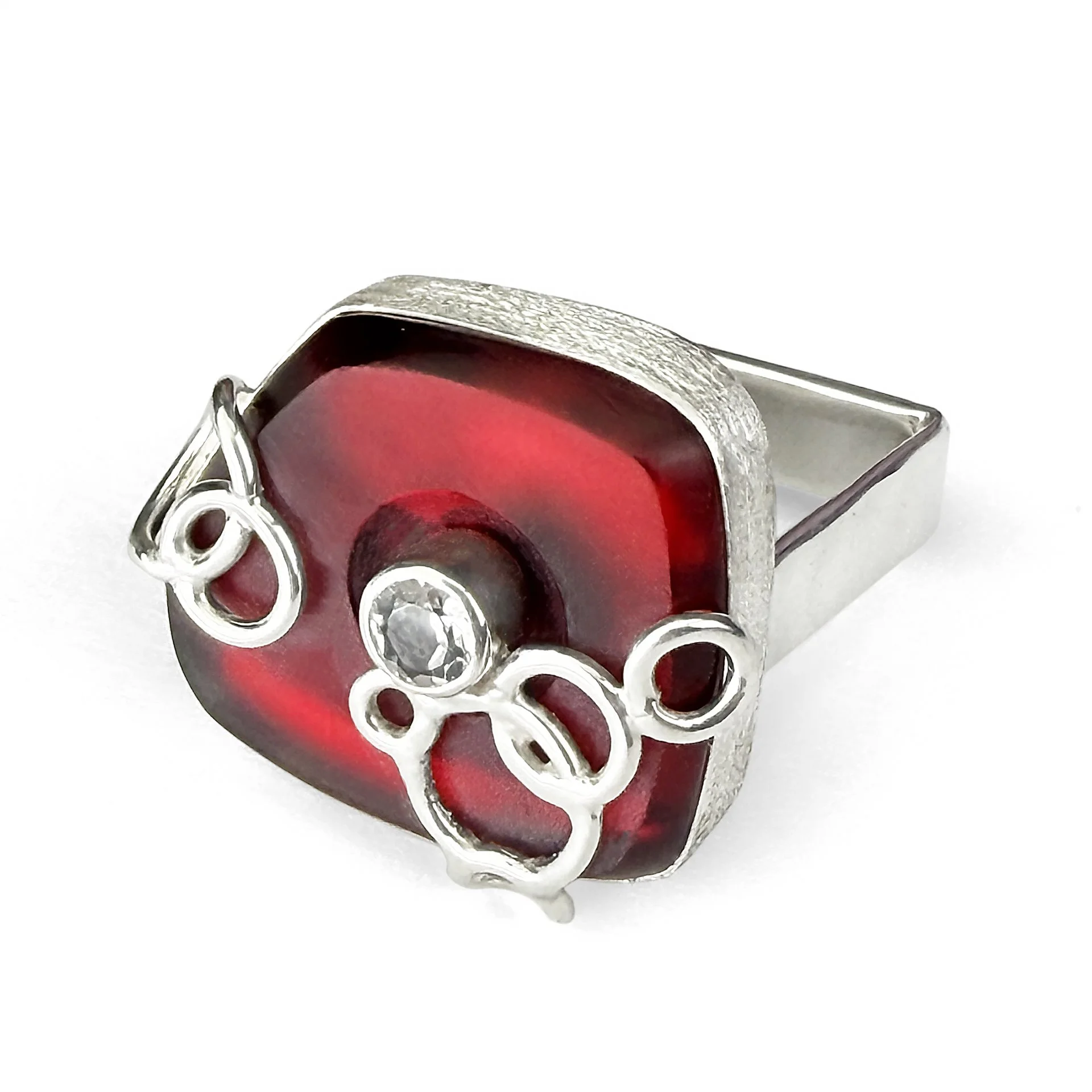
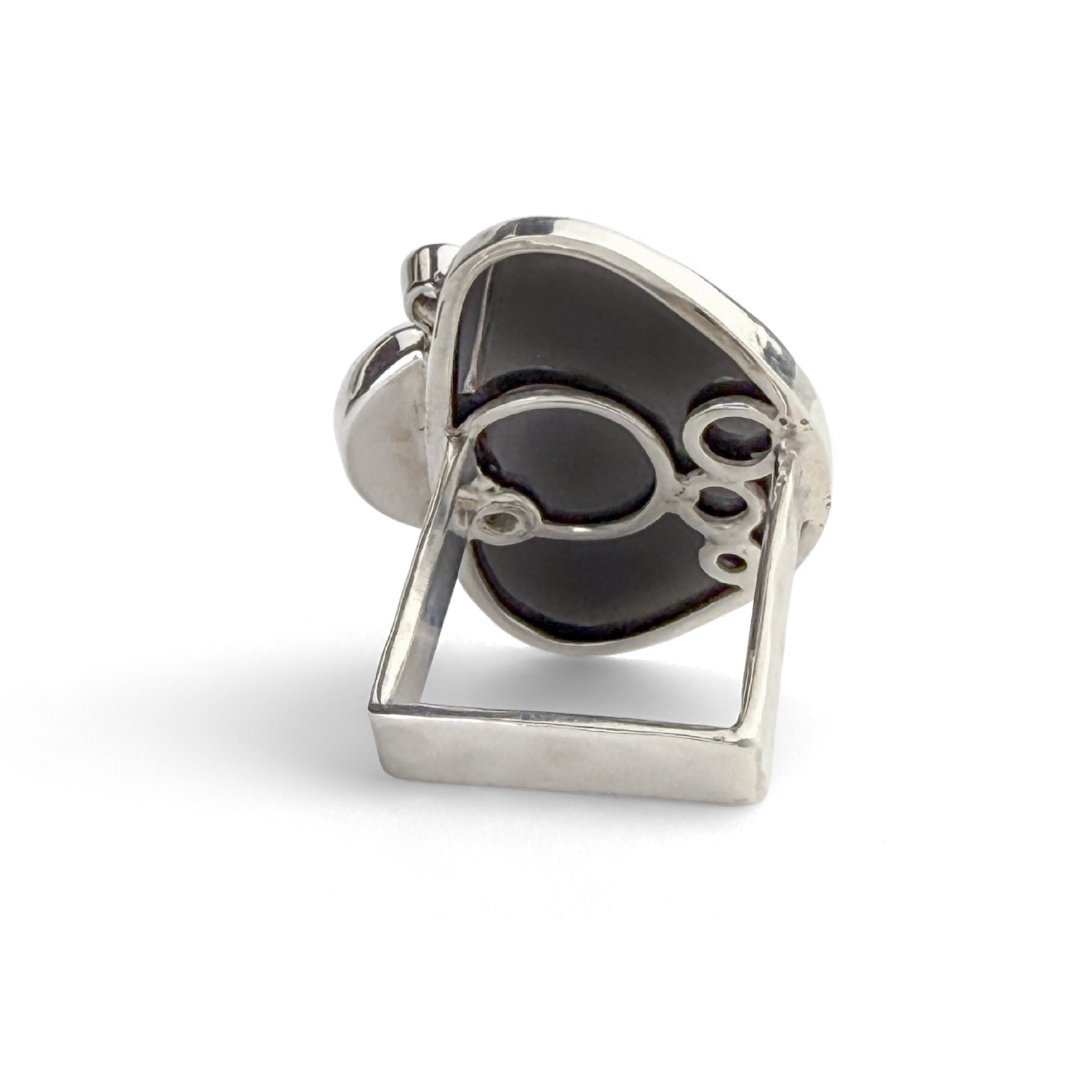
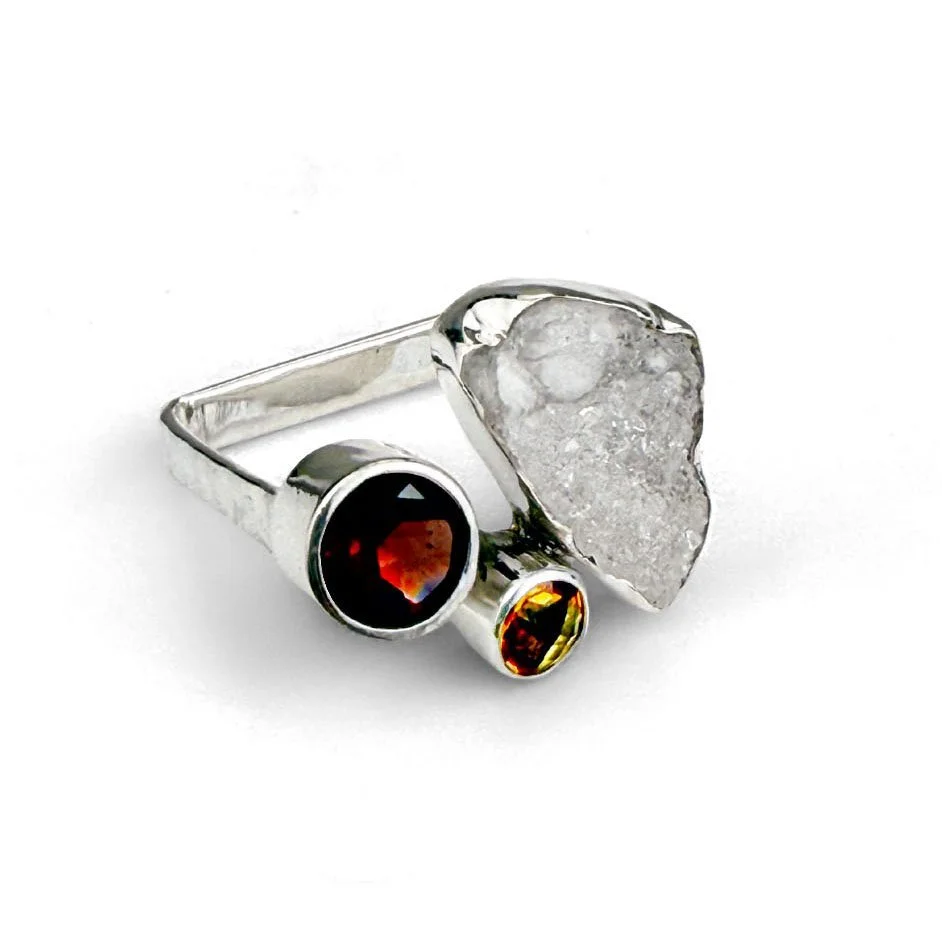
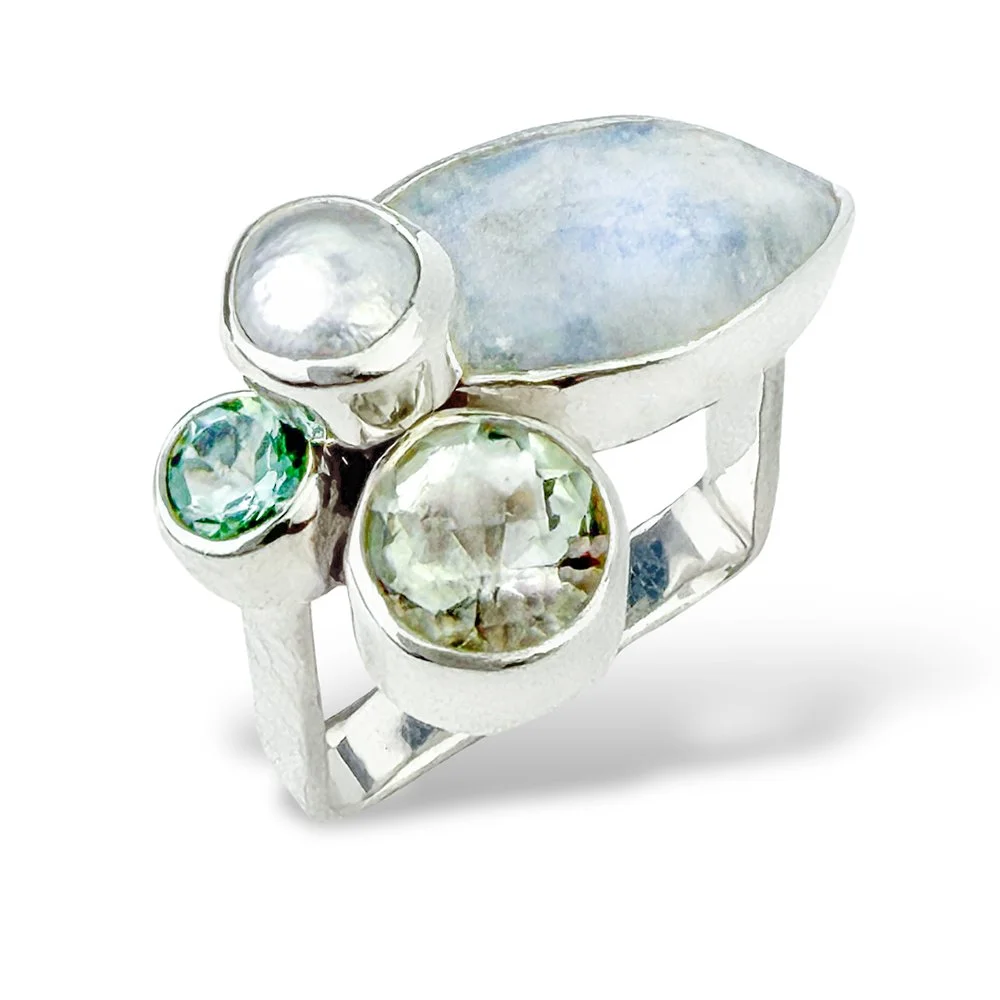
Yes, it is.
I've been making square rings for years, and I get questions about them constantly. Some people aren't sure what to make of them at first, but once I explain the thinking behind them, they're usually converts.
The obvious reason is sculptural. A square profile adds an architectural quality to a design that a round band just can't. But honestly, the practical reasons are just as compelling.
For anyone who deals with mid-day swelling or knuckles that have a mind of their own, square rings offer a little more grace. The corners give you extra room where you need it. And because of the straight wall, the fit is more forgiving overall. If a ring is a hair too big, it won't spin or slide off the way a round ring would. That also means you have a little more flexibility wearing it on different fingers.
And here's something most people don't realize until they try one on: once it's on your finger, you can't feel the difference between a square shank and a round one. It's completely comfortable.
And if you have a top-heavy design, which, let's be honest, I often do, a square ring stays put. No flopping to one side. What you see is what you get, all day long. They are sized, so it's not a one size fits all situation, but the flexibility is real. A square ring will work with you in a way a round one often won't.
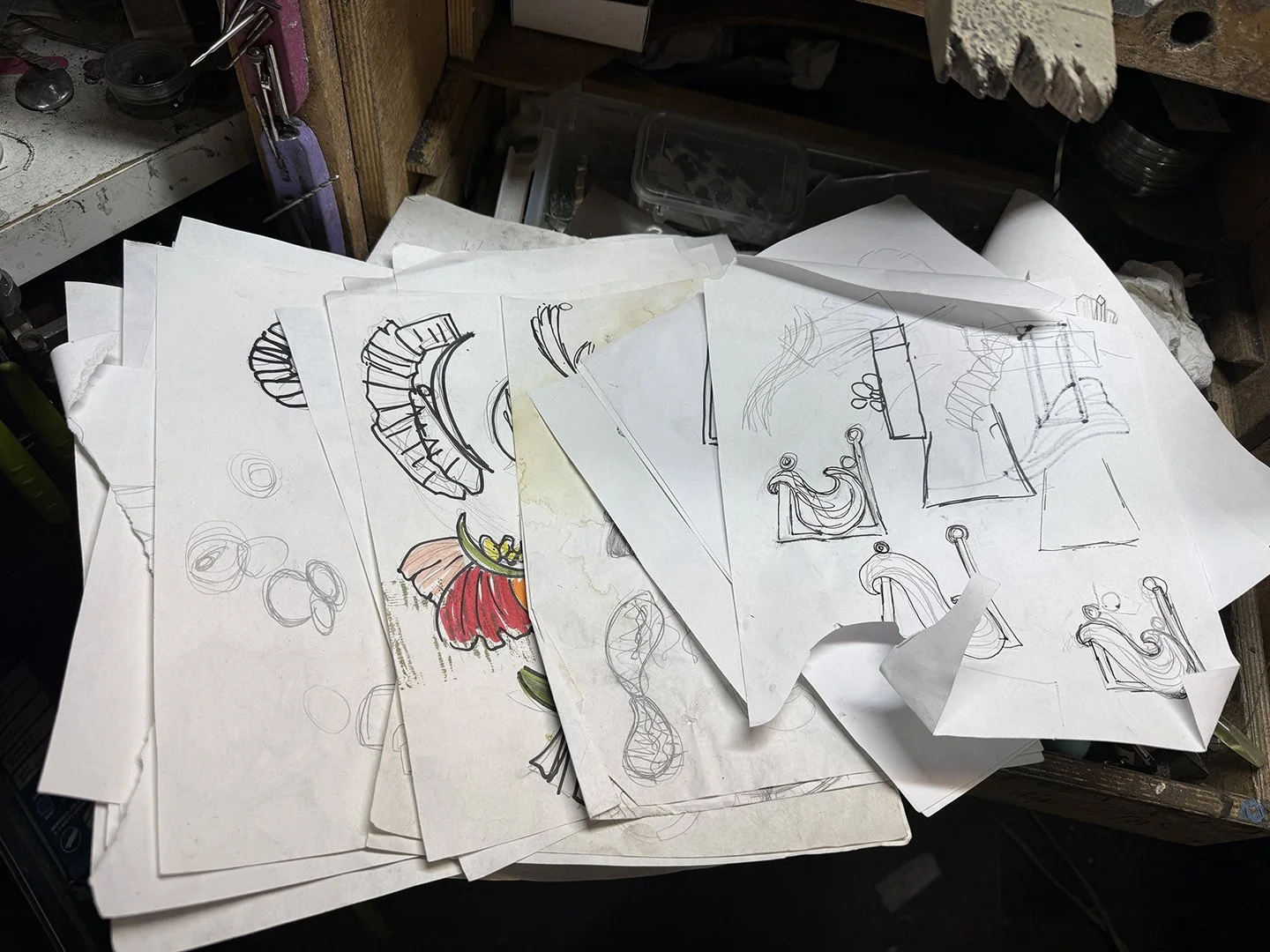
A stack of sketches. I’ve got 30+ years of these in boxes.
6. Where do you get your ideas from?
This might be the hardest question to answer, because it's not something I can always articulate. The short answer is: I don't really know, and everywhere.
The longer answer is that there's a constant dialogue running in the back of my brain, always scanning for forms, textures, and color combinations that catch my attention. Nature, travel, the glass itself. Everything is fair game.
I've kept sketchbooks since art school, and I flip through old ones when I get bored with my current train of thought or hit a wall entirely. Looking back at those scribbles with fresh eyes has a way of setting the wheels spinning all over again.
Often, I'll carry an idea around for months, sometimes years, before I move forward with it. Part of that is wanting to make sure the idea is truly my own and not something I absorbed from somewhere else, which can be harder to distinguish than you might think. I try to fully flesh things out before I reveal anything to anyone.
At this stage in my career, even if I were somehow influenced by another maker, by the time I evolved the idea through my own process and technique, it wouldn't resemble anyone else's work anyway. But the sitting with things matters to me. If you were to throw the work of a hundred contemporary jewelry makers on a table, I feel mine would be easily recognizable.
7. How do I decide what to make?
How I decide what to make at any given time depends on a few factors: what sells quickly, what people at shows seem most drawn to, and what gaps I notice in my inventory. But if I'm being honest, it’s pretty much dictated by my mood. Whatever I feel like making in that moment probably holds the most weight. (There, I said it.)
I am always, and I mean always, thinking about what the next series will be. To feed that, I give myself time every week to just play. To experiment, push things forward, see what happens. Sometimes that leads to something completely new. Sometimes it means returning to a previous body of work to reimagine it or continue in a direction I'd only started to explore.
And sometimes I make something and it's just... not working. So, I put it aside. A month later, or even years later, I come back to it -- and somehow, magically, I know exactly how to make it work. I have no good explanation for that. I've just learned to trust it.
8. Are you able to support yourself doing this?
Yes. I have supported myself as a full-time independent artist for almost 30 years. But I won't pretend it was easy. The first years were rough. There were lean stretches, big financial bets, and plenty of moments where the path forward wasn't obvious. I kept going because there was genuinely nothing else, I could picture myself doing. Fast forward to now: my son is almost 17, my husband is a successful glass sculptor, and I have a thriving business that we fought for every step of the way. It didn't happen overnight. But it happened. And, while writing this answer, I realize that I can (and probably will) write a whole blog about this in the future…so let’s just put a bookmark in this, ok?
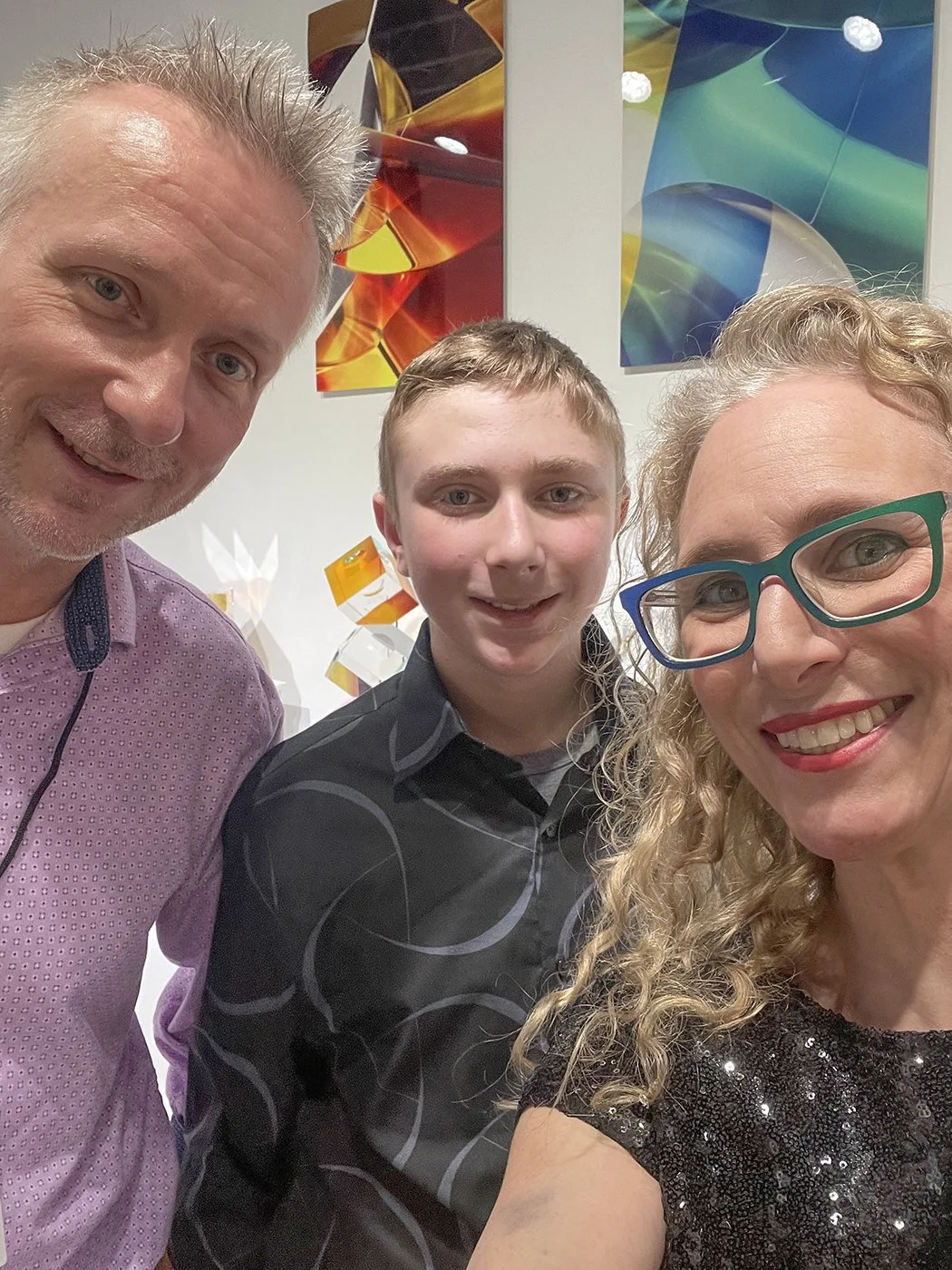
My family in my husband’s booth at a show. (Note the iridescent glasses),
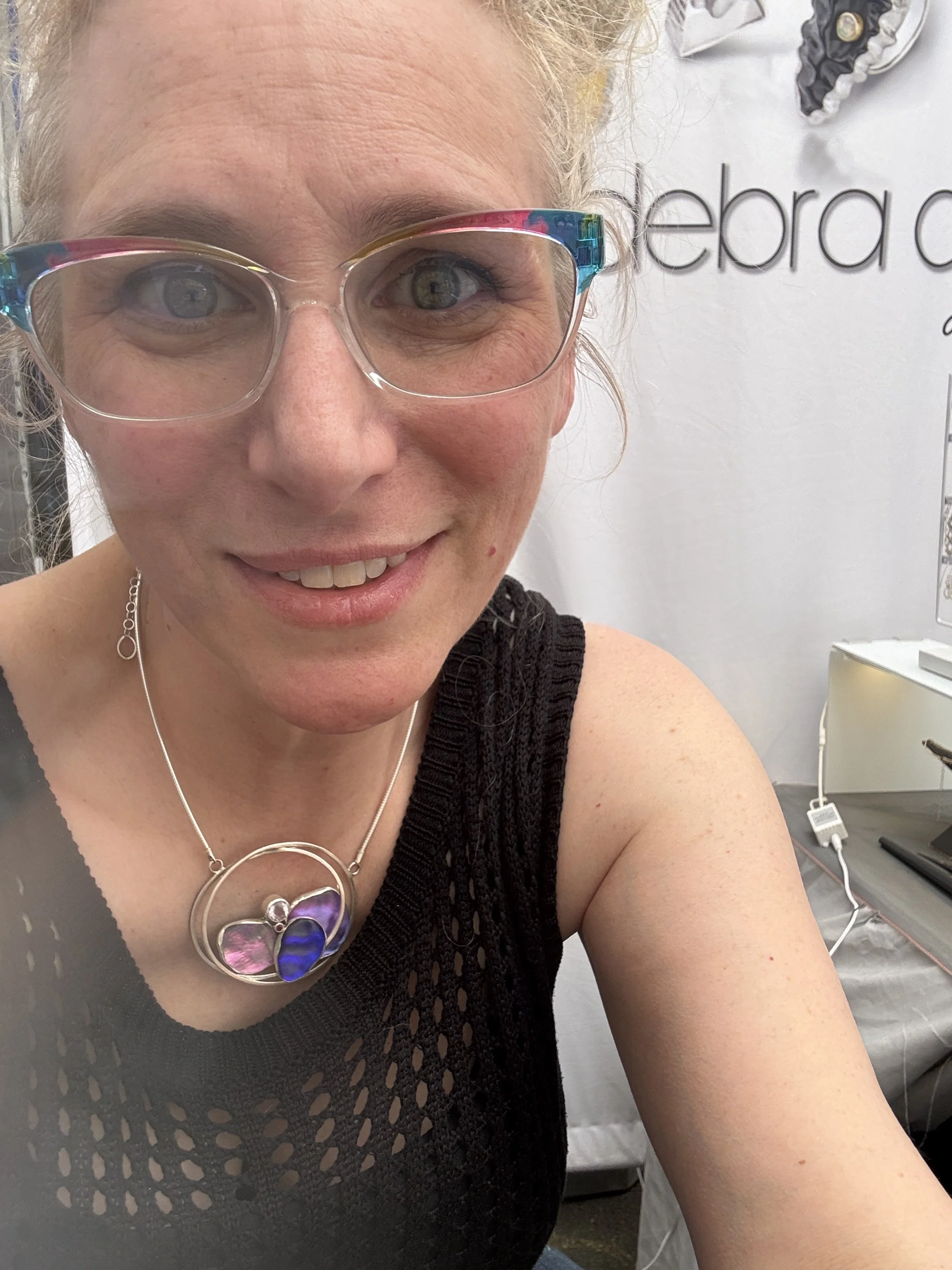
Me, in glasses that I did not make, lol.
9. Did you make your glasses?
Yes, I actually get asked this all the time. And no, I didn't make them. I guess I could, but I'm not an optician, and even if I figured it out, keep in mind that I'm a jeweler and my materials are all precious. They would end up being the world's most expensive glasses. So, I think I'll stick to buying them from people who already have it figured out. I always choose glasses I actually like, because they're on my face all day, and I like colorful, sparkly, rainbow things. Shocking, I know.
10. You must have so much fun!
I guess it's not really a question, but the answer is yes. Absolutely, unequivocally yes.
I love what I do so much that it might sound boastful to say it, but this is all I have ever wanted. I made my mom make me an artist costume for career day in kindergarten. A painter's palette, a smock, and a beret. I have a picture of it somewhere, and now all I can think of is finding it!
There has never been even a fleeting thought in my mind that I would do anything other than make art.
The fact that I get to do this all day, every day, is everything. I throw myself into it completely, my hands are living proof. And if I'm not actually making something at my bench, I'm on my laptop tweaking my website for the 800th time, or editing images, or sketching out new ideas. My son thinks I'm obsessed.
Maybe I am.
But my grandfather always said you need to love what you do, because you spend the majority of your life doing it. I fully agree. And I feel lucky every single day that I found my thing so early, and never let go of it.
Still have a burning question I didn't answer here?
Leave it in the comments. If enough of you are wondering the same thing, or I think it’s an interesting enough question, it might just become its own post. Who knows?!